



Looking for Free Dental Implants Clinical Trials? Read This Before You Wait Another Year in 2026
The year 2026 was supposed to be the turning point for British dentistry, a year where the post-pandemic backlog finally cleared and the National Health Service (NHS) found its footing. Instead, millions of UK citizens find themselves staring at a crumbling system where “free” care is a ghost and private fees have reached an all-time high. If you are currently scouring the internet for free dental implants clinical trials, you are likely motivated by a mix of hope and desperation. You’ve realized that the best dental implants UK specialists offer come with a price tag equivalent to a luxury vehicle, and your dental insurance UK policy likely covers little more than a basic filling.
Contents
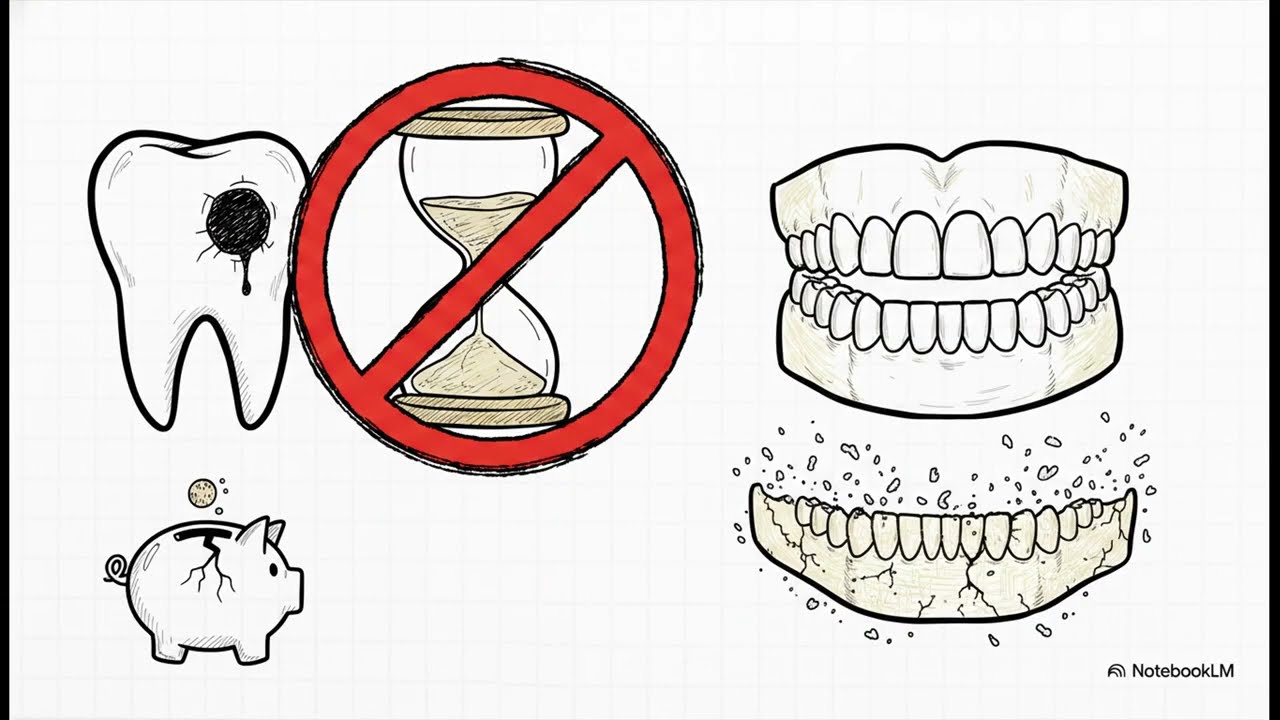
However, before you pin your hopes on becoming a research subject or waiting for an NHS miracle, you must understand the landscape of 2026. Clinical trials are not a “get out of jail free” card for tooth loss; they are rigorous, highly selective, and often come with strings attached that the average patient isn’t prepared for. While the allure of free dental implants is strong, the “cost” of waiting—bone loss, shifting teeth, and declining self-esteem—is a debt that grows every day. In this comprehensive guide, we will dissect the reality of UK clinical trials, analyze the current NHS dental insurance comparison, and show you why thousands of savvy patients are choosing dental implants abroad as their definitive solution.
The Vanishing Promise of “Free” Dentistry in Modern Britain
To understand why so many people are looking for experimental trials, we have to look at the state of the UK’s oral health infrastructure. For decades, the British public relied on the NHS for essential care. But as we move through 2026, the gap between “essential” and “functional” has widened into a canyon. The NHS rarely considers dental implants a necessity, categorizing them instead as a “cosmetic” or “premium” solution, reserved only for those with oral cancer or devastating facial trauma.
For the retiree who has lost teeth to gum disease or the professional who lost a bridge in an accident, the options are bleak. You either pay £2,500 to £4,000 per tooth in a high-street London clinic, or you join a waiting list for a clinical trial that may never even begin recruitment. This systemic failure has created a “dental wasteland” where the only path to a permanent smile seems to be luck or immense wealth.
Why 2026 is the Hardest Year Yet for Dental Patients
We are currently witnessing a “perfect storm” in British dentistry. Inflation has driven up the cost of medical-grade titanium and zirconia, while a shortage of specialized implantologists has sent private surgical fees skyrocketing. Even the most robust cheap dental insurance UK providers have begun capping their payouts for restorative work, leaving patients with massive out-of-pocket gaps.
If you’ve been told you need a full-mouth restoration (All-on-4), you’re looking at a bill that could easily exceed £20,000 in Manchester, Birmingham, or London. It is no wonder that the search volume for “free clinical trials” has hit record highs. But as we will explore in the next section, these trials are not the “free lunch” they appear to be.
What Exactly Are Free Dental Implant Clinical Trials and How Do They Work?
A clinical trial is a primary research study conducted with human participants to evaluate the safety and efficacy of new medical devices or surgical techniques. In the context of dentistry, these trials are usually sponsored by major dental manufacturers (like Straumann or Nobel Biocare) or academic institutions like King’s College London or the University of Manchester.
The primary goal of these trials isn’t to provide you with a free smile; it’s to collect data. When you sign up for free dental implants through a research program, you are essentially trading your time, your medical data, and a degree of physiological risk for the hardware and the surgery.
The Phases of Dental Research: From Lab to Living Tissue
Clinical trials typically move through various phases. By the time a trial reaches the “human” stage, the implant design has usually been tested in laboratory settings.
- Phase I/II: These trials focus on safety and initial performance. They are looking for how the jawbone reacts to a new surface coating or a different screw thread design.
- Phase III: These are larger studies comparing a new implant against the current “gold standard.” This is where most “free” spots open up, as researchers need a diverse demographic to prove the new product works across various age groups and bone densities.
Sponsored Studies vs. University Grant Programs
There is a distinction between a manufacturer-led trial and a university dental school program.
- Manufacturer Trials: These are often the most “high-tech.” They might be testing a 3D-printed titanium implant or a new rapid-healing abutment. They are strictly controlled, and if you have any underlying health issues (like diabetes or a history of smoking), you are almost certainly excluded.
- Dental School Programs: Often confused with clinical trials, these are educational programs where postgraduate students perform surgeries under the supervision of expert consultants. While not always “free,” they are heavily subsidized. However, the wait times for these programs in 2026 have exceeded three years in most major UK cities.
When you look for the best dental implants UK researchers are testing, you must ask yourself: Am I comfortable being ‘Patient Zero’ for a new piece of hardware just to save money? For many, the answer is a hesitant “yes,” but the barrier to entry remains incredibly high.
One of the most common misconceptions circulating in UK community forums and social media groups is that the NHS provides dental implants for anyone who has lost a tooth and cannot afford private care. In 2026, the reality is far more clinical and, frankly, exclusionary. The NHS operates on a strict “medical necessity” framework, which is audited with extreme rigour to manage dwindling budgets.
To be eligible for free dental implants through the NHS, your tooth loss must usually be the result of a profound medical condition or trauma. This typically includes:
- Oral Cancer: Patients who have undergone reconstructive surgery involving the jaw.
- Cleft Lip and Palate: Individuals with congenital abnormalities requiring structural dental support.
- Severe Trauma: Victims of serious accidents (e.g., car crashes) where the jawbone has been compromised.
- Partial Anodontia: Rare genetic condition where multiple teeth fail to develop naturally.
The Strict Medical Necessity Threshold
If you have lost your teeth due to age-related wear, standard tooth decay, or long-term periodontal (gum) disease, you are almost 100% certain to be rejected for NHS implants. The system’s default solution for these cases is a removable partial or full denture. While dentures provide a basic functional replacement, they do nothing to prevent the jawbone resorption that follows tooth loss.
Why Tooth Loss from Age or Decay Rarely Makes the Cut
The NHS logic is simple: if a functional alternative (dentures) exists, the taxpayer will not fund a “premium” surgical solution like an implant. This leaves the average Briton in a “Dental No-Man’s Land.” You aren’t “sick” enough for the NHS to help, but you aren’t wealthy enough to pay £3,000 for a single tooth at a private clinic. This is precisely why the search for dental implants abroad has transitioned from a niche luxury to a mainstream necessity for the UK middle class.
NHS vs. Clinical Trials: Why the 3-Year Waiting List is Failing UK Patients
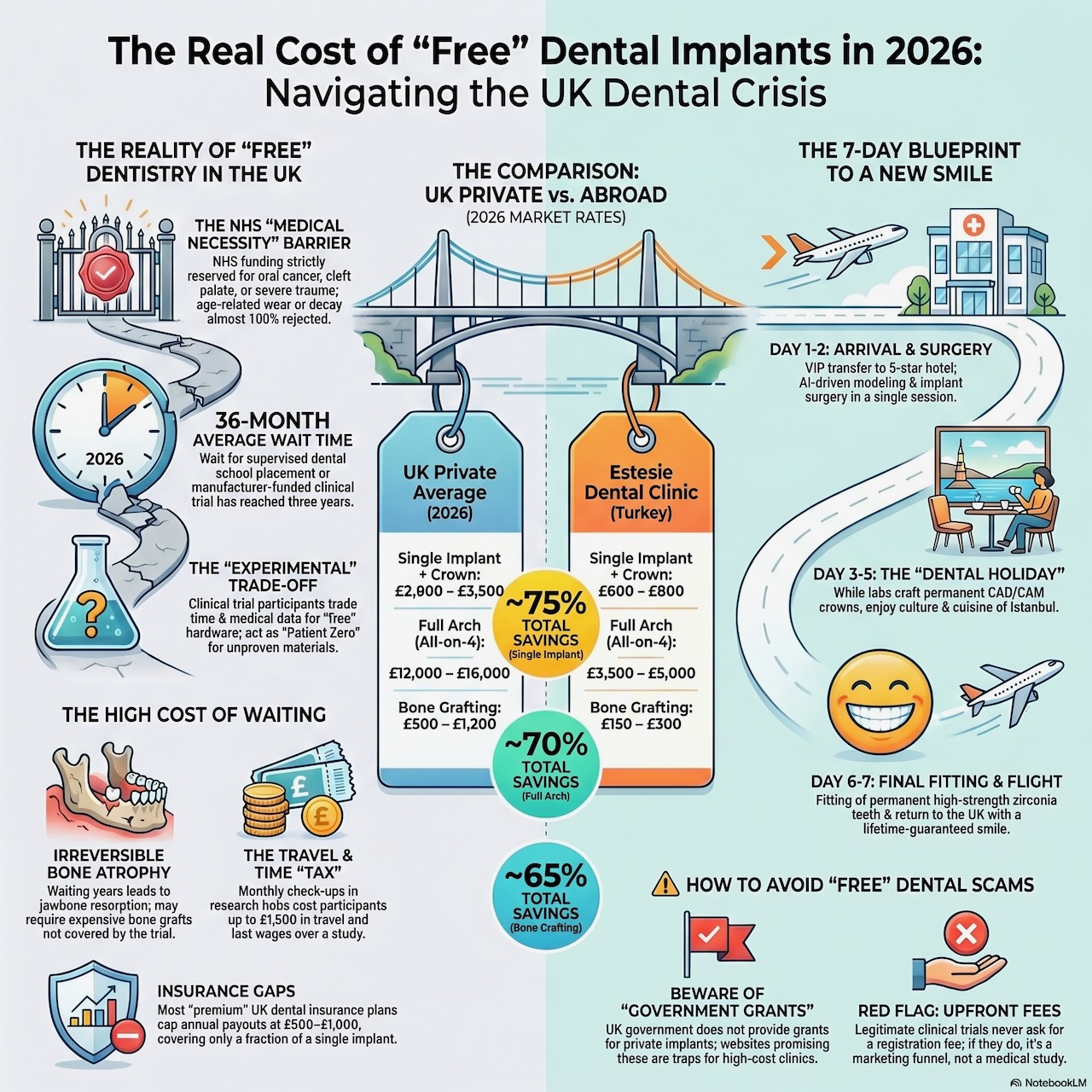
If the NHS rejects you, your next thought is likely the clinical trial route. But the queues here are just as daunting. In early 2026, the average waiting time for a supervised dental school placement or a manufacturer-funded trial in the UK had reached a staggering 36 months.
The Socio-Economic Impact of Dental Neglect
Waiting three years for a tooth is not just an inconvenience; it is a health risk. When a tooth is missing, the surrounding teeth begin to “tip” or migrate into the gap, throwing off your bite (occlusion) and causing potential TMJ (Temporomandibular Joint) disorders. Furthermore, the bone in the extraction site begins to melt away (atrophy). If you wait three years for a “free” trial, you may find that by the time your name is called, you no longer have enough bone to support an implant, requiring an expensive bone graft that the trial might not even cover.
Comparing NHS Dental Insurance: Is It Worth the Premium?
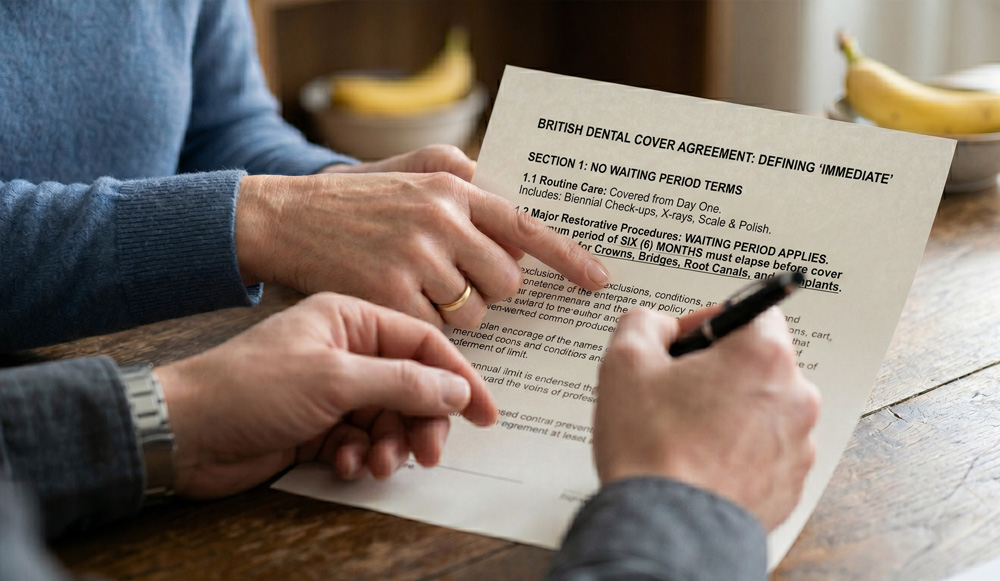
Many patients attempt to bypass these waits by looking at an NHS dental insurance comparison or upgrading to private dental insurance UK plans. However, 2026 policy wordings are notoriously restrictive:
- Waiting Periods: Most “Premium” plans require you to be a member for 12–24 months before claiming for “Major Restorative” work.
- Annual Caps: Even the best dental implants UK insurance policies often cap their annual payout at £500 or £1,000. Considering a single implant costs £2,500+, the insurance barely scratches the surface.
- Pre-existing Conditions: If you are already missing the tooth when you sign up, the insurance will almost certainly refuse to pay for the implant.
When you weigh the cost of monthly premiums against the measly coverage provided, most find that saving that money for dental implants abroad is a much more mathematically sound strategy.
The Hidden Costs Behind “100% Free” Dental Research Programs
The word “free” is a powerful marketing tool, but in the world of clinical research, it is rarely absolute. If you are lucky enough to be accepted into a study for free dental implants, you must be prepared for the logistical and physical “taxes” involved.
Travel, Time, and Post-Operative Maintenance
Clinical trials are rarely local. Most are concentrated in major research hubs like London, Leeds, or Edinburgh. As a participant, you are often required to attend monthly or even bi-weekly check-ups for the first year. These aren’t 15-minute appointments; they involve extensive X-rays, 3D scans, and data collection. If you live two hours away, the cost of petrol, train tickets, and unpaid time off work over three years can quickly add up to £1,500—half the price of a private implant.
The Price of “Experimental” Risk
You must also consider the “Research” aspect. These trials are testing something. It might be a new type of connection between the implant and the crown, or a new ceramic material. If the experimental component fails, the trial protocol might only cover the removal of the failed hardware. It may not cover the “rescue” surgery needed to fix the damage.
Compare this to the predictable, world-class care at Estesie Dental Clinic, where we use proven, gold-standard materials like Straumann and Nobel Biocare. You aren’t a test subject; you are a patient receiving a bespoke, guaranteed medical service.
Why Dental Schools Might Reject Your Application for Free Implants
UK Dental Schools are inundated with thousands of applications every month. To manage this, their “screening” process is incredibly narrow. They aren’t looking for the most “deserving” patient; they are looking for the “perfect” teaching case.
You will likely be rejected if:
- Your case is too simple: If it’s too easy, the students don’t learn enough.
- Your case is too complex: If you have severe bone loss or require a sinus lift, it may be too risky for a student to handle.
- You have health complications: Smoking, controlled diabetes, or even high blood pressure can disqualify you immediately to protect the school’s success statistics.
This “Goldilocks” requirement—your case must be not too easy, not too hard, but just right—means that 90% of applicants are turned away after months of waiting for an assessment.
The Time Factor: Can You Really Afford to Wait Years for a Trial to Open?
In 2026, the most valuable commodity is time. Every month you live with missing teeth, your facial structure changes. The “sunken” look associated with old age is actually a result of bone loss in the jaw. By searching for “free” options, many patients inadvertently spend more on “temporary” fixes like flippers or dentures that need constant relining.
If you are tired of the “search and wait” cycle, it is time to look at the best dental implants UK residents are now flocking to in record numbers. By shifting your perspective toward dental implants abroad, you can move from “searching for a trial” to “walking out with a smile” in as little as seven days.
How to Spot Fake “Free Dental Implant” Scams and Grants Online
As the dental crisis in the UK deepens in 2026, a predatory industry of “Dental Grant” websites has emerged. If you have been searching for free dental implants, you have likely encountered flashy advertisements promising “Government Grants” or “100% Funded Dental Schemes.”
Here is the professional reality: The UK government does not provide grants for private dental implants. These websites are almost always “lead generation” traps. They collect your sensitive medical and contact data and sell it to high-cost private clinics. You then receive a call from a salesperson offering a “discount” that still leaves the price far higher than what you would pay for dental implants abroad.
Red Flags to Watch For:
- Vague Eligibility: If a site says “everyone qualifies,” it’s not a medical study—it’s a marketing funnel.
- Upfront Fees: Legitimate clinical trials will never ask you to pay a registration fee.
- “Official” Looking Seals: Be wary of sites using NHS-style logos or government-looking crests that aren’t hosted on
.nhs.ukor.gov.ukdomains.
The Smart Alternative: Premium European Implants for a Fraction of UK Private Fees
While the UK system remains stalled, the global medical landscape has evolved. The concept of dental implants abroad—specifically in Turkey—has matured into a sophisticated, high-tech industry that often surpasses the equipment and service levels of local UK high-street dentists.
Why Dental Implants Abroad Offer Better Tech at Lower Prices
It is a common misconception that “cheaper” means “lower quality.” The lower price point in Istanbul is driven by lower operational costs, favourable exchange rates, and a highly competitive medical tourism market.
At Estesie Dental Clinic, we utilize the exact same European and Swiss hardware used by the best dental implants UK specialists. We offer:
- Digital Smile Design (DSD): 3D AI-driven modeling of your future smile.
- Zirconia and Titanium Excellence: Only using Tier-1 brands like Straumann.
- Surgical Speed: What takes 18 months in the UK (due to appointment spacing) takes 5–7 days in our clinic.
Price Comparison: UK Private Clinics vs. Estesie Dental
To make an informed decision, you need hard numbers. Below is a realistic comparison based on 2026 market rates.
| Treatment Type | UK Private Average (2026) | Estesie Dental Clinic | Savings |
| Single Implant + Crown | £2,800 – £3,500 | £600 – £800 | ~75% |
| Full Arch (All-on-4) | £12,000 – £16,000 | £3,500 – £5,000 | ~70% |
| Bone Grafting | £500 – £1,200 | £150 – £300 | ~65% |
For a live, up-to-date breakdown of our current fees, please visit our Prices Page. You will find that even when you factor in a luxury hotel and flights, you are still saving thousands of pounds compared to a “cheap” UK option.
One of the biggest hurdles to starting treatment is the initial diagnostic cost. In London, a comprehensive implant consultation—including a CBCT Scan—can cost upwards of £300.
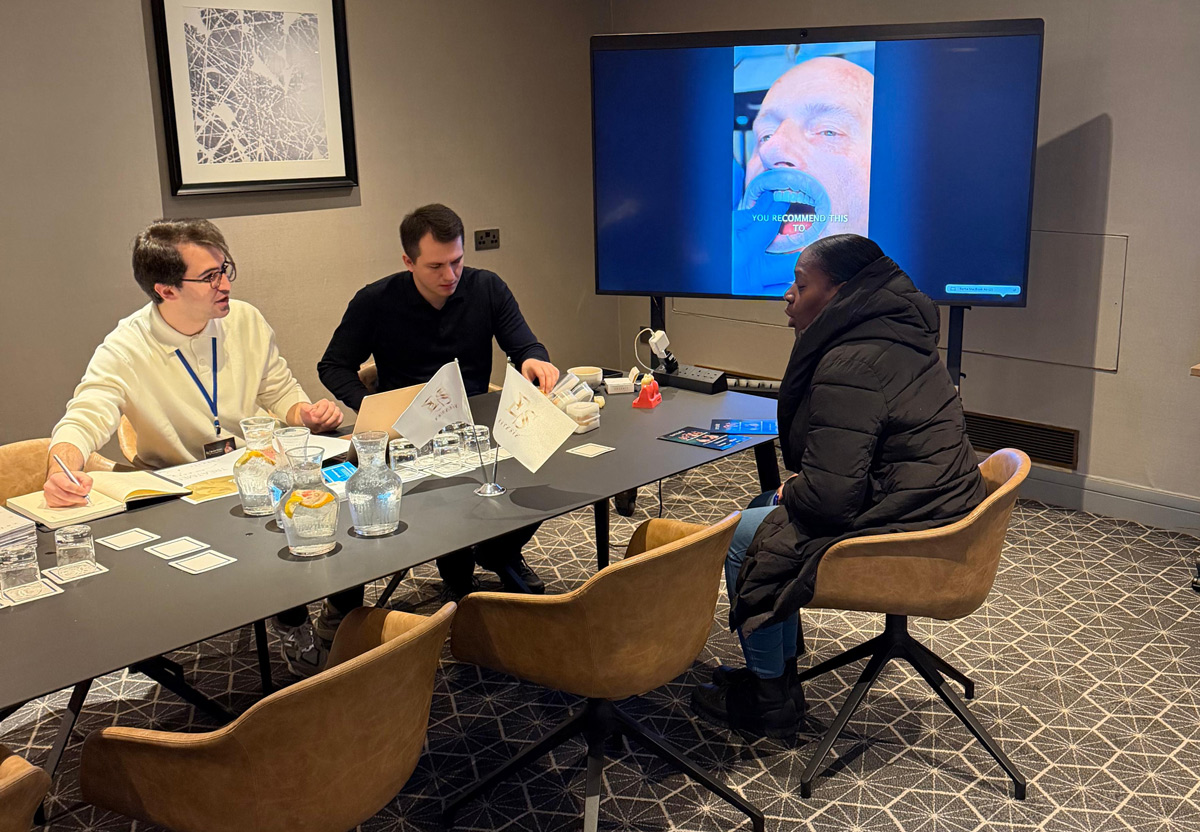
We believe you shouldn’t have to pay just to find out if you are a candidate. Estesie Dental Clinic frequently hosts Free UK Consultation Days in major cities like London and Birmingham. These are not sales pitches; they are clinical assessments where you can meet our specialists, discuss your X-rays, and receive a fixed-price treatment plan with no hidden extras.
Urgent Advice: If you are currently in pain or have a failing bridge, do not wait for a “trial” that may never happen. You can get an immediate professional opinion by contacting our specialists via WhatsApp for a Digital Consultation. Simply send a photo or a recent X-ray, and we will provide a preliminary plan within 24 hours.
From a Free Consultation in London to a Permanent Smile in Istanbul: The 7-Day Blueprint
If you decide that waiting for the NHS or a clinical trial is no longer a viable life strategy, here is what the “Fast-Track” to a new smile looks like with us.
- Day 1: Arrival & VIP Transfer: You are met at the airport by a private driver and taken to your 5-star hotel.
- Day 2: Clinical Precision: We perform high-definition 3D scans and the implant surgery in a single session. Using “Immediate Loading” techniques where possible, you may even leave with a temporary fixed bridge.
- Day 3-5: The “Dental Holiday”: While our lab technicians hand-craft your permanent crowns using CAD/CAM technology, you are free to enjoy the world-class culture and cuisine of Istanbul.
- Day 6: Final Fitting: We fit your permanent, high-strength zirconia or porcelain teeth. We check the bite, the aesthetics, and the comfort.
- Day 7: Fly Home: You return to the UK with a lifetime-guaranteed smile, having spent less than the cost of a used car.
This blueprint isn’t a “trial” or an “experiment”—it is a streamlined medical process that has helped thousands of UK patients reclaim their ability to eat, speak, and smile with confidence.
H2: FAQ: Navigating the 2026 Dental Landscape
Searching for free dental implants in the UK can be a minefield of misinformation. Below, we answer the most pressing questions for British patients considering their options in 2026.
Are there legitimate free dental implant clinical trials near me in 2026? While some exist at major dental schools like the Eastman Dental Hospital or through specialized research units, they are rare and highly specific. Most “free” trials are currently full or have waiting lists stretching into late 2027. If you need a solution now, waiting for a trial is often the most expensive choice in terms of bone health.
How can I apply for university dental school implant programs in the UK? Applications usually go through your local NHS dentist, who must provide a referral. However, schools only accept “ideal” teaching cases. If your case is complex or you have any health issues, you will likely be rejected. At Estesie Dental, we handle the most complex cases—including those rejected by UK schools—daily.
Why did the NHS reject my application for free dental implants? The NHS typically only funds implants for victims of trauma or oral cancer. Missing teeth due to decay or age are considered “cosmetic” or “standard” issues, for which the NHS only offers dentures. This is why dental implants abroad have become the standard solution for the average UK patient.
Do I qualify for free implants if I have severe bone loss or gum disease? Ironically, severe bone loss often disqualifies you from free trials or NHS care because the surgery becomes too “advanced” for a student or a standard research protocol. Conversely, our clinic in Istanbul specializes in advanced bone grafting and sinus lifts that UK clinics often charge thousands for.
How long is the waiting list for a dental implant clinical trial in Britain? In 2026, the average wait is 3 to 4 years. During this time, your jawbone will likely shrink, making the eventual surgery more difficult. You can bypass this entire wait and be finished with treatment in just one week by contacting our specialists today.
Can pensioners, veterans, or low-income adults get free implants in 2026? Unfortunately, there is no automatic entitlement based on age or veteran status. Unless you meet the strict “medical trauma” criteria, the answer is usually no. This has forced many on a budget to seek out cheap dental insurance UK plans, only to find the coverage is insufficient.
What are the hidden risks of participating in a dental implant research study? The primary risk is the “unknown” factor of experimental hardware. If an experimental screw fails, you may be left with damaged bone and no insurance to cover the repair. At Estesie, we only use proven, world-leading brands that come with a lifetime guarantee.
Do free clinical trials cover the extra costs like bone grafting and sinus lifts? Rarely. Most trials only provide the implant and crown. If you need a sinus lift (which many long-term tooth loss patients do), you often have to pay for that privately in the UK, which can cost £1,000+.
Is dental tourism a safer alternative to waiting for a UK clinical trial? Yes, provided you choose a reputable clinic like Estesie Dental. Unlike a trial, where you are a research subject, in Istanbul, you are a private patient receiving the highest tier of established medical technology, often at a price lower than a “partially funded” UK trial.
How can I fix my missing teeth if I cannot afford UK private dentistry? The most effective way is to look at the best dental implants UK patients are getting in Turkey. By cutting out the massive overheads of UK clinics, you can access premium Swiss and German implants for up to 70% less.
How do I book a free face-to-face implant assessment in the UK right now? You can skip the digital queue by booking one of our free London consultation days. This allows you to get a full clinical plan without paying the £300 fee usually charged by UK specialists.
Is it possible to get full-mouth implants (All-on-4 / All-on-6) for free? In 2026, it is virtually impossible to get a full-mouth restoration for free in the UK. These complex surgeries are rarely included in trials. However, our prices page shows that a full-mouth restoration in Istanbul is often cheaper than a single tooth in London.
Conclusion: Reclaiming Your Quality of Life
The dream of “free” dental care in the UK has, for most, become a frustrating cycle of rejection letters and endless waiting lists. While the search for free dental implants clinical trials is an understandable reaction to the current cost-of-living crisis, the hidden costs—the loss of bone, the loss of confidence, and the physical risk of experimental research—are far too high.
In 2026, you don’t have to be a research subject to afford a premium smile. By choosing dental implants abroad at a world-class facility like Estesie Dental Clinic, you are choosing certainty over hope. You are choosing a clinic that understands the UK dental crisis and offers a direct, affordable, and medically superior path to recovery.
Stop waiting for a “trial” that may never come. Your health and your smile are worth more than a spot on a three-year waiting list.
Final Call to Action: Take the First Step Today
Ready to stop searching and start smiling? We make the transition from the UK to our Istanbul clinic seamless.
- Free Digital Evaluation: Send us your dental photos or X-rays via WhatsApp for an immediate preliminary plan.
- Video Consultation: Speak directly with our lead surgeons from the comfort of your home.
- Price Transparency: Review our transparent implant price list and see exactly how much you will save.
Don’t let another year pass you by. Contact Estesie Dental Clinic today and discover why we are the trusted choice for hundreds of UK patients every month.