



Dental Implants Turkey vs UK: A Scientific Analysis of Quality, Cost, and Clinical Excellence
The decision to undergo major oral surgery is rarely taken lightly, particularly when the choice involves international travel. In the contemporary landscape of medical tourism, the comparison of dental implants Turkey vs UK has become a focal point for patients seeking to balance clinical excellence with financial viability. This comprehensive analysis serves as a definitive guide for patients, dental professionals, and researchers, exploring the multifaceted dimensions of dental implant technology, regulatory frameworks, and the socio-economic factors driving the shift toward globalization in healthcare.
Contents
The Evolution of Oral Rehabilitation: Understanding Dental Implants
To appreciate the nuances of the dental implants Turkey vs UK debate, one must first understand the biological and mechanical sophistication of the procedure itself. Osseointegration, a term coined by Professor Per-Ingvar Brånemark, refers to the structural and functional connection between living bone and the surface of a load-bearing artificial implant. This process is the cornerstone of modern restorative dentistry.
Unlike traditional dentures or bridges, a dental implant acts as a prosthetic tooth root, typically manufactured from biocompatible materials such as titanium or zirconia. When considering dental implants Turkey vs UK, the fundamental science remains constant; however, the delivery of care, the cost of materials, and the clinical environment vary significantly between these two jurisdictions.
The Biological Mechanism of Tooth Loss and Restoration
When a natural tooth is lost, the underlying alveolar bone begins to undergo resorption, a process where the bone density diminishes due to lack of stimulation. Dental implants are unique because they provide the necessary mechanical stimulation to the jawbone, effectively halting bone loss. This preventative aspect is a primary reason why many UK patients seek treatment abroad—to access high-quality preventative care that might be financially prohibitive in their home country.
Is it worth going to Turkey for dental implants?
One of the most frequent questions posed by prospective patients is whether the logistical effort of traveling abroad outweighs the benefits. The answer lies in a tripartite evaluation: clinical quality, technological integration, and the “Patient Experience” (PX).
Clinical Quality and Professional Expertise
Turkey has invested heavily in its medical infrastructure over the last two decades. The Turkish Ministry of Health (T.C. Sağlık Bakanlığı) maintains rigorous standards for clinics catering to international patients. When comparing dental implants Turkey vs UK, it is vital to note that Turkish dentists often perform a higher volume of implant surgeries per year than their UK counterparts, potentially leading to increased clinical proficiency in complex cases.
Technological Integration
Turkish dental centers, particularly in hubs like Istanbul and Antalya, often utilize the latest CAD/CAM (Computer-Aided Design and Computer-Aided Manufacturing) technology and 3D cone beam computed tomography (CBCT). These tools allow for guided surgery, which increases the precision of implant placement and reduces recovery times.
How much do dental implants cost in Turkey compared to the UK?
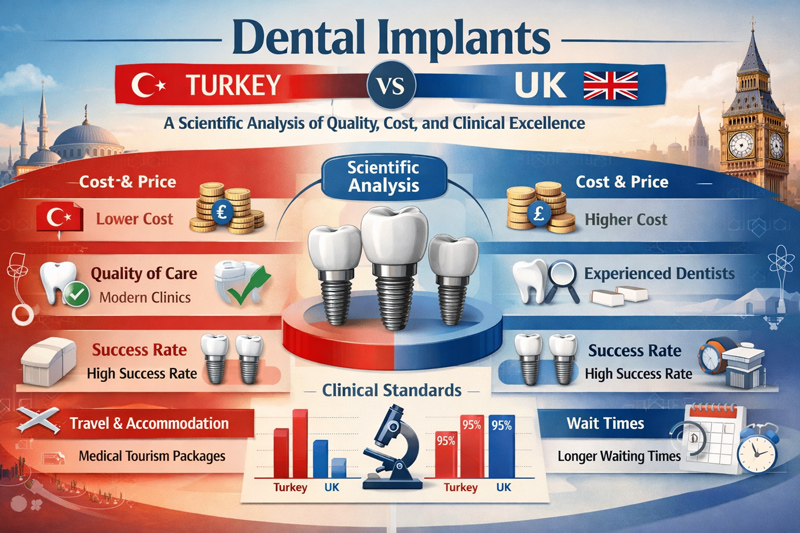
The economic disparity is perhaps the most significant driver in the dental implants Turkey vs UK discourse. In the United Kingdom, a single dental implant—including the post, abutment, and crown—can range from £2,000 to £3,500. For patients requiring full-mouth restoration, such as the All-on-4 protocol, costs can exceed £25,000.
In contrast, the same high-quality materials (such as Straumann or Nobel Biocare) in Turkey are often available at 50% to 70% less.
Factors Influencing the Cost Difference
- Operational Overheads: Rent, labor, and insurance premiums are significantly lower in Turkey.
- Currency Exchange Rates: The strength of the British Pound (GBP) against the Turkish Lira (TRY) provides significant purchasing power to UK residents.
- Government Incentives: The Turkish government provides subsidies to clinics engaged in health tourism to bolster the national economy.
Which country has the best dental implants?
When discussing “best,” one must distinguish between the brand of the implant and the expertise of the clinician. The global market is dominated by a few major manufacturers. A “top-tier” implant in the UK is identical to a “top-tier” implant in Turkey.
Global Market Leaders in Implantology
Most reputable Turkish clinics use Swiss, German, or American implant systems. These include:
- Straumann: Renowned for their SLA surface technology which accelerates osseointegration.
- Nobel Biocare: Pioneers of the All-on-4 technique.
- Osstem/Hiossen: Leaders in high-stability designs for immediate loading.
The “best” country is ultimately the one where the clinician follows evidence-based prosthodontic protocols and provides transparent aftercare.
Will UK dentists work on “Turkey Teeth”?
There is a common misconception that UK dentists will refuse to treat patients who have had work done in Turkey. While some practitioners may be hesitant to intervene in the immediate post-operative phase due to liability concerns, most will provide routine maintenance and hygiene services.
The Estesie Dental Advantage
At Estesie Dental Clinic, we recognize the importance of clinical continuity. To bridge the gap between dental implants Turkey vs UK, we have integrated a team of specialists who have graduated from prestigious institutions in the United Kingdom. This ensures that our patients receive treatment that aligns with General Dental Council (GDC) standards while benefiting from the cost-efficiencies of Turkey. Our UK-trained doctors understand the specific expectations and clinical requirements of British patients, facilitating a seamless transition of care.
How long do I have to stay in Turkey for dental implants?
The timeline for dental implants is dictated by biology rather than geography. However, the logistical planning for dental implants Turkey vs UK usually involves two distinct phases:
- Phase One (Surgical): This involves the placement of the implant body into the bone. A stay of 3 to 7 days is typically required.
- Healing Period: The bone remodeling process (osseointegration) takes between 3 to 6 months. During this time, the patient returns home with a temporary restoration.
- Phase Two (Prosthetic): The patient returns to Turkey for the fitting of the permanent crown or bridge. This usually requires a stay of 7 to 10 days to ensure the occlusion and aesthetics are perfect.
Is it safe to go to Turkey for dental work?
Safety is a paramount concern in any medical procedure. When evaluating the safety of dental implants Turkey vs UK, it is essential to look at infection control protocols and the regulatory environment.
Regulatory Oversight in Turkey
Clinics in Turkey must be licensed by the Ministry of Health and often hold international certifications such as ISO 9001. Furthermore, many clinics are accredited by the International Congress of Oral Implantologists (ICOI).
Mitigation of Risks
The risks associated with dental implants—such as peri-implantitis or nerve damage—exist regardless of the country. Safety is maximized when a patient chooses a clinic that prioritizes:
- Pre-operative CBCT scanning.
- Sterile surgical environments.
- Comprehensive medical history reviews.
Where are the cheapest All-on-4 dental implants in the world?
While Turkey is a leading contender for affordability, other nations like Mexico, Thailand, and Hungary also compete in the “value” segment. However, Turkey often wins on the “Value-to-Quality” ratio due to its modern infrastructure and proximity to Europe.
The All-on-4 technique is a specialized procedure that requires high levels of surgical skill. Seeking the “cheapest” possible price without regard for the clinician’s experience can lead to complications. In the context of dental implants Turkey vs UK, Turkey offers a “premium for less” rather than just a “cheap” alternative.
Comparative Analysis: The UK Healthcare System vs. Turkish Private Dentistry
The NHS and Private Sector in the UK
In the UK, dental implants are rarely available on the National Health Service (NHS) unless there is a significant medical necessity (e.g., oral cancer or trauma). Most patients must seek private care, where wait times can be long and prices are fixed at a high baseline to cover the immense costs of regulation and indemnity insurance.
The Turkish Private Model
Turkish clinics operate primarily on a private, competitive model. This competition has driven a “technological arms race,” where clinics compete by offering the most advanced laser dentistry or digital workflow solutions. This environment benefits the patient, providing access to cutting-edge care that is often more advanced than a standard UK high-street practice.
Clinical Protocols: Step-by-Step Implantology
When choosing dental implants Turkey vs UK, patients should be aware of the standardized clinical steps involved in a successful restoration.
- Consultation and Radiographic Analysis: Using orthopantomogram (OPG) and CBCT to assess bone volume.
- Bone Grafting (Optional): If bone density is insufficient, a bone graft or sinus lift may be necessary.
- Implant Placement: A minimally invasive surgical procedure under local anesthesia.
- Healing Abutment: A small “shaping” piece is placed to guide the gum tissue.
- Final Impression: Taking digital or manual molds for the permanent prosthesis.
- Loading: The final crown is attached.
Psychological Impacts of Dental Restoration
The benefits of dental implants extend beyond mastication. There is a significant psychological component to oral health. Patients suffering from edentulism often experience reduced self-esteem and social anxiety. The accessibility of dental implants Turkey vs UK allows more individuals to reclaim their social confidence through affordable full-mouth rehabilitation.
Conclusion: Making an Informed Choice
The debate of dental implants Turkey vs UK is not about which country is “better,” but which option aligns with the patient’s specific clinical needs, budget, and comfort level. Turkey offers an unparalleled combination of advanced technology, high-volume surgical expertise, and significant cost savings. However, the key to success lies in choosing a clinic that prioritizes transparency, utilizes world-class implant brands, and employs clinicians with international training.
By choosing a facility like Estesie Dental Clinic, where the gap between Turkish efficiency and UK academic standards is bridged by our UK-educated doctors, patients can enjoy the best of both worlds: a world-class smile without the prohibitive British price tag.
Further Reading and References
- Journal of Oral Implantology
- The British Dental Journal (BDJ)
- International Journal of Oral & Maxillofacial Implants
Would you like me to expand on the specific surgical protocols for All-on-4 implants or provide a detailed breakdown of the different types of bone grafting materials used in Turkish clinics?